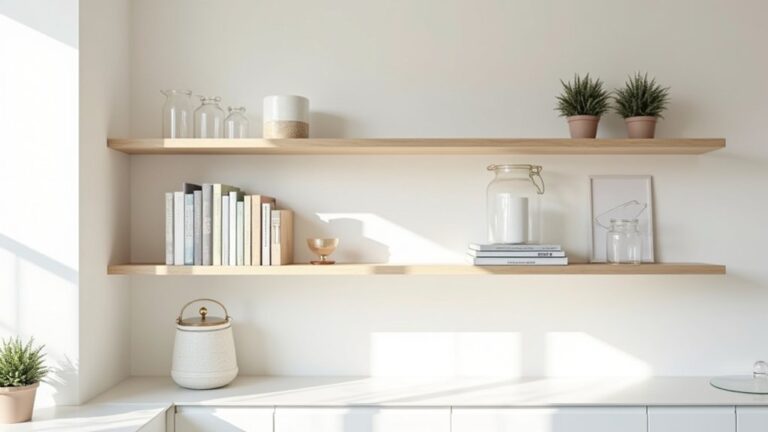
To nail open shelving without the clutter, you’ll need to be intentional about what you display. Group similar items together, create breathing space between objects, and follow the rule of three for visual harmony. Consider both function and style—keep everyday items accessible while tucking less attractive pieces lower. Regular dusting and seasonal rotation will keep your shelves fresh. Remember to vary heights and textures, but don’t overcrowd. Your kitchen’s personality can shine through thoughtfully curated shelves.
The Essentials
- Group similar items by color, shape, or function to create visual harmony while maintaining organization.
- Leave adequate breathing space between displayed items to prevent visual chaos and clutter.
- Rotate objects seasonally to maintain freshness while incorporating complementary colors for visual appeal.
- Position frequently used items at eye level for accessibility, and store less attractive necessities on lower shelves.
- Use decorative baskets and containers to corral smaller items while contributing to the overall aesthetic.
The Psychology Behind the Open Shelving Trend

While many dismiss open shelving as merely a passing design fad, there’s actually fascinating psychology behind why we’re drawn to this style of kitchen storage. The visual appeal goes deeper than aesthetics—it’s about creating an emotional connection with your space.
You might notice how open shelving creates a sense of expanded space perception, making even smaller kitchens feel more breathable. This ties directly to minimalist design principles where less truly becomes more.
A clutter-free environment isn’t just pleasing to the eye; it actually reduces stress levels when you enter your kitchen. And there’s something deeply satisfying about personal expression—displaying items that tell your story rather than hiding everything away.
Your kitchen becomes a place that feels authentic to you, not just functional but meaningful.
Assessing Your Space: Where Open Shelving Works Best
Before installing open shelving, you’ll want to assess your kitchen corners for unused potential – those awkward spots might actually be perfect for displaying your prettiest dishes or most-used items. You should also consider how people move through your space, since shelving that disrupts natural pathways will quickly become frustrating rather than functional. Taking time to map out these practical considerations now will help you create open shelving that works with your home instead of against it.
Kitchen Corner Analysis
The kitchen corner presents a unique opportunity for open shelving that many homeowners overlook. These angled spaces often become dead zones in your kitchen layout, but they don’t have to be. You can transform that awkward corner into a focal point with the right shelving approach.
Think about corner functionality when planning. Would L-shaped shelves work better than straight ones? Maybe floating corner shelves that follow both walls? Your specific kitchen dimensions matter here.
The corner actually provides more visual impact than standard wall space. You might display your prettiest dishes or most-used items there. Just be careful not to overload it—corners can feel cluttered quickly.
Have you considered how corner shelving affects your workflow? Placing everyday items in these spots can improve your kitchen’s productivity while adding style.
Room Flow Considerations
Moving beyond specific corners, successful open shelving depends largely on understanding your kitchen’s overall flow. Think about how you actually use the space day-to-day. Where do you prep meals? Where do you find yourself reaching for items most often?
Your room layout should inform shelf placement—not the other way around. Don’t force shelving where it interrupts natural pathways. Notice the areas where you frequently pause or pivot while cooking. These change zones are usually poor candidates for open shelving.
Space enhancement isn’t just about maximizing storage. It’s about making your kitchen feel right. Sometimes fewer, well-placed shelves create better flow than cramming them everywhere possible. Try visualizing your typical movements through the kitchen. Where would shelves enhance rather than hinder your routine?
Curating Your Collection: What Deserves Display Space

You’ll want to create visual balance when filling your open shelves, grouping similar items together while leaving some breathing room. Try to maintain a mix of heights, textures, and colors that feels intentional but not too perfect—maybe that ceramic vase next to your favorite cookbooks, with some space between. Don’t forget you can swap things out as the seasons change, bringing holiday pieces forward in winter or showcasing lighter collections during summer months.
Visual Balance Matters
When designing open shelving for your home, visual balance transforms ordinary displays into striking focal points. Understanding visual weight helps you arrange items so your shelves don’t look lopsided or chaotic. Heavier objects (like large books or ceramics) need counterbalancing with lighter elements.
Try applying basic symmetry principles without being too rigid. Maybe you’ll place similar-sized objects on opposite ends of a shelf, or create a rhythm with repeating elements. You don’t need perfect matching—actually, it’s better if things aren’t too perfectly aligned.
What about color distribution? Dark objects appear visually heavier than light ones, so spread them thoughtfully. And remember to vary heights and textures, creating natural movement across your shelves. Sometimes stepping back and squinting helps you see if anything feels off balance.
Rotate Seasonal Items
The three most impactful seasonal rotations for open shelving happen when you shift between major seasons. Your display strategies should evolve with the weather, creating a home that feels in sync with what’s happening outside your windows. This keeps your shelves looking fresh without requiring a complete redesign.
Consider these key moments for rotating your seasonal decor:
- Spring/Summer – Swap heavy items for lighter colors, beach finds, and glass that catches sunlight
- Fall – Introduce warmer tones, textured ceramics, and natural elements like pinecones
- Winter Holidays – Make room for festive pieces, meaningful heirlooms, and cozy accents
You’ll find this rhythmic changing of your shelves becomes something you look forward to. It’s not just about decoration—it’s about marking time in your home.
The Rule of Three: Creating Visual Harmony on Shelves
One timeless design principle can transform your open shelving from cluttered to curated: the rule of three. This simple approach suggests grouping items in threes, creating natural shelf symmetry that’s pleasing to the eye without feeling rigid or overly planned.
Try arranging books, a small plant, and a framed photo together. Or maybe a candle, decorative box, and a meaningful trinket. The combinations are endless, really. What matters is creating little vignettes that tell your story.
When selecting decorative accents, think about varying heights and textures while maintaining a cohesive color palette. You’ll find this approach works well in almost any room—kitchens, living areas, even bathrooms.
Want to refresh your look? Just rearrange your groupings or swap out a piece or two.
Color Theory for Shelf Styling

Color theory might seem intimidating at first, but you’ll find it’s actually quite intuitive when applied to open shelving. The right color combinations can transform your shelves from cluttered displays into cohesive design statements. Think about what feeling you want your space to evoke—hue psychology suggests blues create calm while yellows energize.
When styling your shelves, consider these color approaches:
- Monochromatic – Varying shades of a single color create depth while maintaining visual harmony
- Complementary – Opposite colors on the color wheel (like blue and orange) create lively, eye-catching displays
- Analogous – Colors that sit next to each other on the color wheel offer a subtle, sophisticated look
Want to test a color scheme before committing? Try arranging a few objects first, then step back. Does it feel right to you?
Balancing Form and Function in Kitchen Open Storage
Moving from color theory to practical application, kitchen open shelving presents a unique challenge. You’re constantly maneuvering the tension between functionality versus aesthetics in this high-traffic space.
Your everyday dishes need to be accessible, but you don’t want your shelves looking cluttered or messy. Try grouping similar items together—stacking plates, clustering mugs, or arranging bowls by size. This creates visual order while maintaining practicality.
Consider clever storage solutions like decorative baskets for smaller items or those things you use less frequently but still need nearby. Maybe place attractive containers at eye level and tuck less visually pleasing necessities on lower shelves?
Remember that kitchen shelving, unlike display shelving elsewhere, gets used daily. Your beautiful arrangement will shift as you cook and clean, so aim for systems that are easy to maintain, not just pretty to look at.
Maintenance Strategies: Keeping Dust at Bay

While open shelving brings style and accessibility to your space, the unavoidable reality of dust accumulation requires thoughtful maintenance. Let’s face it—dust is persistent, but with the right approach, you’ll keep your shelves looking their best without daily cleaning.
Your shelf materials matter tremendously in dust prevention. Glass and metal shelving tend to show dust more quickly than natural wood, which can sometimes camouflage light particles until your weekly cleaning day.
- Rotate items regularly to prevent dust buildup in forgotten corners
- Keep a small duster nearby for quick, daily touch-ups rather than deep cleanings
- Apply a thin layer of furniture wax on wooden shelves—it repels dust particles and makes wiping down much easier
What’s your biggest open shelving maintenance challenge? Most people find that consistency, not effort, is the key.
Seasonal Rotation: Refreshing Your Shelves Throughout the Year
The beauty of open shelving lies not just in its functionality, but in its potential for change throughout the year. You don’t need to completely overhaul your shelves to keep them looking fresh—just rotate a few key pieces as seasons shift.
In spring, try incorporating fresh plants and lighter ceramics. Summer might call for coastal elements and brighter colors. When fall arrives, swap in warmer tones and perhaps some seasonal themes like small pumpkins or amber glassware. Winter offers perfect opportunities for holiday decor without overwhelming the space.
Think about keeping a small storage bin for each season, filled with pieces you can easily exchange. This way, your shelving stays versatile without requiring major effort. Remember, sometimes less is more—you might just need to change out three or four items to transform the entire feel.
Common Mistakes to Avoid When Styling Open Shelves

When designing open shelving, even the most style-conscious homeowners can fall into common traps that undermine the entire look. You might love the idea of displaying everything, but shelf overcrowding quickly transforms your stylish storage into visual chaos.
- Overcrowding your shelves – Leave breathing room between items. Your eye needs places to rest, and your shelves need negative space to highlight what’s important.
- Displaying too many mismatched items – While some variety adds interest, completely random objects create confusion rather than cohesion. Try grouping similar colors or shapes together.
- Forgetting about function – Beautiful shelves should still be practical. What’s the point if you can’t easily grab that cookbook or coffee mug you use daily?
Have you considered which of these mistakes might be happening in your own home right now?
Frequently Asked Questions
How Much Weight Can Open Shelving Typically Support?
Your open shelving’s weight capacity depends on shelf materials and weight distribution. Typically, wooden shelves support 20-40 pounds, while metal or reinforced options can hold up to 100 pounds per linear foot when properly installed.
What’s the Ideal Spacing Between Individual Shelves?
For ideal shelf spacing, you’ll want 10-12 inches vertically for practical use. Consider your shelf height based on what you’re displaying and your design aesthetics. You can adjust spacing for taller items or visual balance.
Can Open Shelving Work in High-Humidity Areas Like Bathrooms?
Yes, you can use open shelving in bathrooms if you choose humidity resistant materials like marine-grade wood, metal, or glass. They’re perfect for bathroom organization when properly sealed and regularly maintained to prevent moisture damage.
How Do I Install Floating Shelves Securely Into Drywall?
You’ll need to locate wall studs using a stud finder for secure installation. Choose sturdy shelf materials and have the right installation tools like a level, drill, and anchors if you can’t hit studs directly.
Are There Child-Safety Concerns With Open Shelving?
Yes, open shelving poses risks for children. You’ll need smart child proofing strategies like securing heavy items, using shelf brackets with no sharp edges, and considering higher shelf placement beyond little hands’ reach.
Final Thoughts
You’ve got what you need to make open shelving work in your home. Remember, it’s about balance—showcase what matters, hide what doesn’t. Don’t worry about getting it perfect right away. Try different arrangements, step back, adjust. Your shelves will evolve as you do.
Maybe that’s the real beauty of open shelving? It’s never really finished, just like your home—always becoming more you.