
You’d think picking a coffee table would be simple, but it’s surprisingly easy to get wrong. Too big and it crowds the room. Too small and it looks lost. The shape matters, the material matters, and honestly, so does how you place it. There’s a lot to think through before you buy. So where do you even start?
The Essentials
- Choose a coffee table about two-thirds the sofa’s length, maintaining 18 inches of space between the sofa and table edge.
- Match table shape to sofa style; round tables suit sectionals, while rectangular tables complement straight sofas.
- For loveseats, use proportionally smaller tables with open bases to avoid overcrowding and maintain visual lightness.
- Select materials based on lifestyle; wood feels warmer, metal reads cooler, and glass requires frequent cleaning.
- Keep table decor minimal, ensure clear pathways, and position the table for easy accessibility to drinks and snacks.
Size, Scale, and Height: Getting the Proportions Right
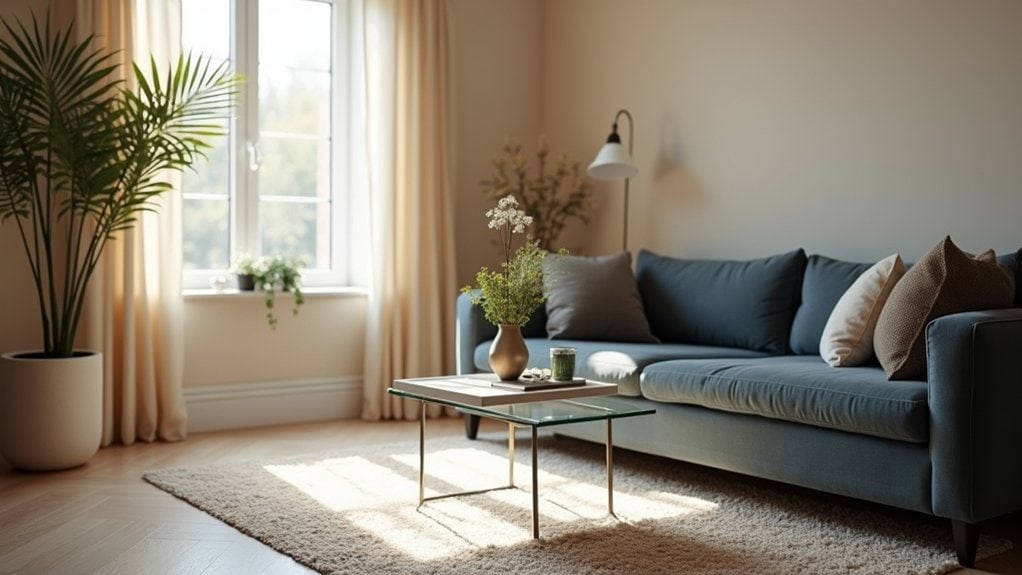
Getting the size of your coffee table right is honestly one of the more important decisions you’ll make for your living room. Too big and you’re constantly bumping into it. Too small and it just looks… lost.
A good rule for proportion balancing is keeping your table around two-thirds the length of your sofa. So if your sofa runs 90 inches, you’re looking at roughly 60 inches for your table. That’s not a hard rule, but it’s a decent starting point.
Height considerations matter more than people realize. Your table should sit close to the same height as your sofa cushions — usually somewhere between 16 and 18 inches.
Does your current table feel slightly off? That might be exactly why.
Which Coffee Table Shape Suits Your Sofa?
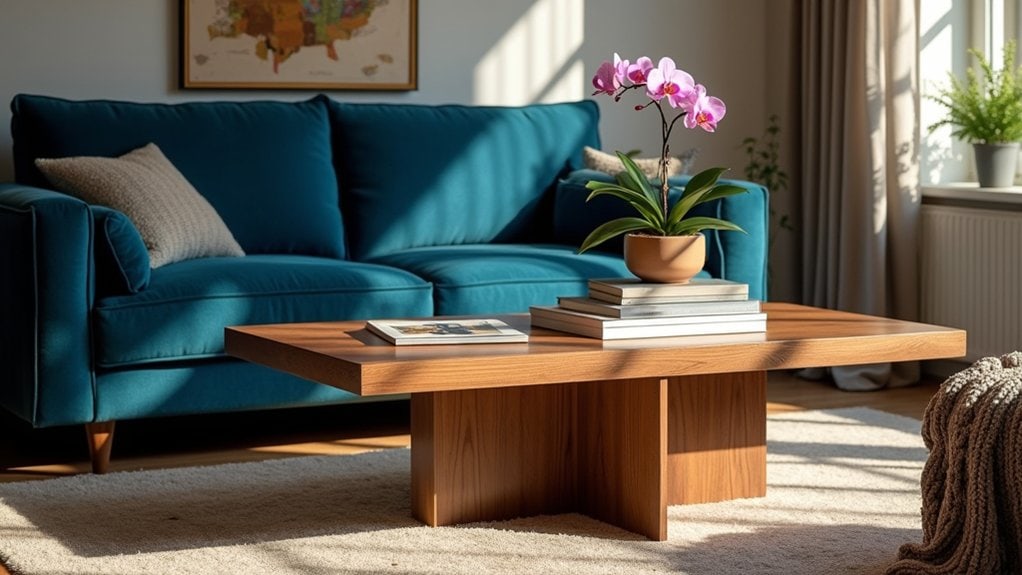
The shape of your coffee table matters more than you might think, especially when you’re trying to match it to your sofa. If you’ve got a sectional, a round table works better because it softens the sharp angles and keeps traffic flow open. Straight sofas pair well with rectangular tables, and if your sofa’s on the smaller side, don’t overdo it—keep the table small too.
Sectional Sofas Need Round Tables
If you’ve got a sectional sofa, you’ve probably noticed that a rectangular coffee table can feel a little off — too rigid, too linear against all those curves and angles.
Round tables actually solve this in a pretty practical way. The sectional compatibility here is real — a round table fits naturally into the open pocket of an L-shaped or U-shaped sectional without blocking traffic flow or creating awkward corners.
Think about how you actually move around your space. Sharp corners on a coffee table become obstacles fast.
Round table benefits go beyond aesthetics. You get easier movement, fewer bumped shins, and a layout that just breathes better.
Does your sectional curve to the left? The table’s shape shouldn’t fight that. It should quietly work with it.
Straight Sofas Suit Rectangles
When your sofa runs in a clean, straight line, a rectangular coffee table just makes sense. The parallel lines feel natural together, and honestly, it’s one of those sofa styles where the shape decision kind of makes itself.
A rectangular table gives you real surface area. You can spread things out—books, a tray, a drink. That matters more than people think.
Among table designs, longer rectangles work especially well with bigger sofas. But don’t automatically go oversized. Does your space actually have room to walk around it comfortably?
Keep about 18 inches between the sofa and table. That’s enough room without feeling disconnected.
Straight sofas are pretty forgiving, so you’ve got some flexibility. Just don’t overthink it too much.
Small Sofas, Small Tables
Bigger sofas get a lot of attention, but smaller ones have their own set of considerations.
If you’re working with a compact loveseat or a petite sectional, a large rectangular table will just crowd the space. Small space solutions matter here. You want something that keeps the room breathing.
A round or oval table tends to work well. No sharp corners cutting into the walkway. It keeps cozy arrangements feeling intentional rather than just… cramped.
Size-wise, your table shouldn’t exceed two-thirds of your sofa’s length. That’s a rough guide, not a hard rule.
Ask yourself how you actually use the table. If it’s mostly for setting down a drink or a book, you don’t need much surface area at all.
The Best Coffee Tables for Sectional Sofas
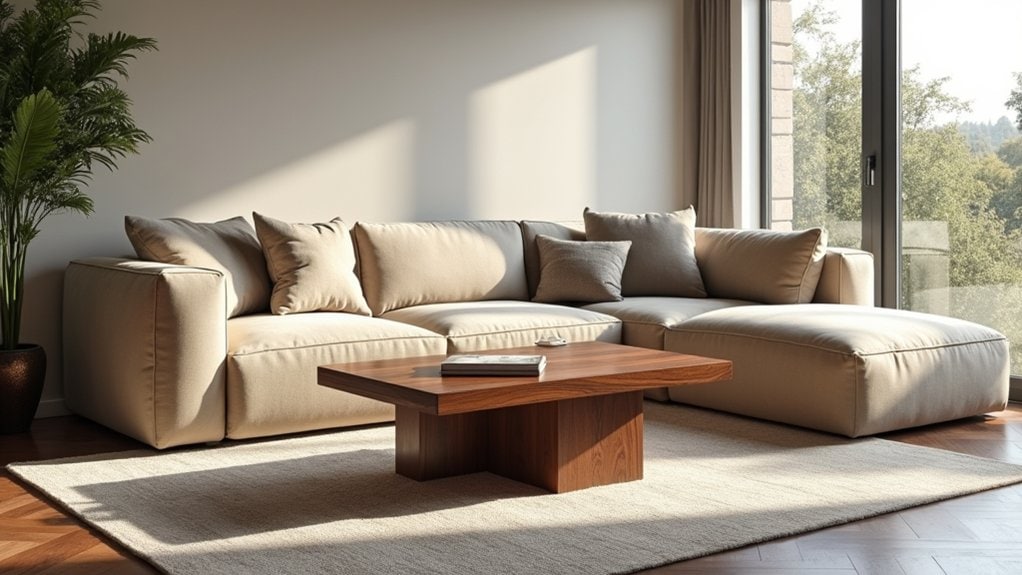
Sectional sofas take up a lot of space, and that changes everything about how you pick a coffee table.
You’re not just filling a room—you’re working around a large, oddly shaped piece of furniture. So what actually works?
Oversized rectangular tables tend to fit well in front of longer sectional runs. But if your sectional wraps into an L-shape, you might want to think about two smaller tables instead of one big one.
Different coffee table styles hit differently here. A low, square table can anchor the open corner nicely. Decorative accents like trays or small objects help define the surface without cluttering it.
Don’t overthink matching everything perfectly. Just make sure you can reach your coffee without leaning too far forward.
Coffee Tables That Work With Loveseats and Small Sofas
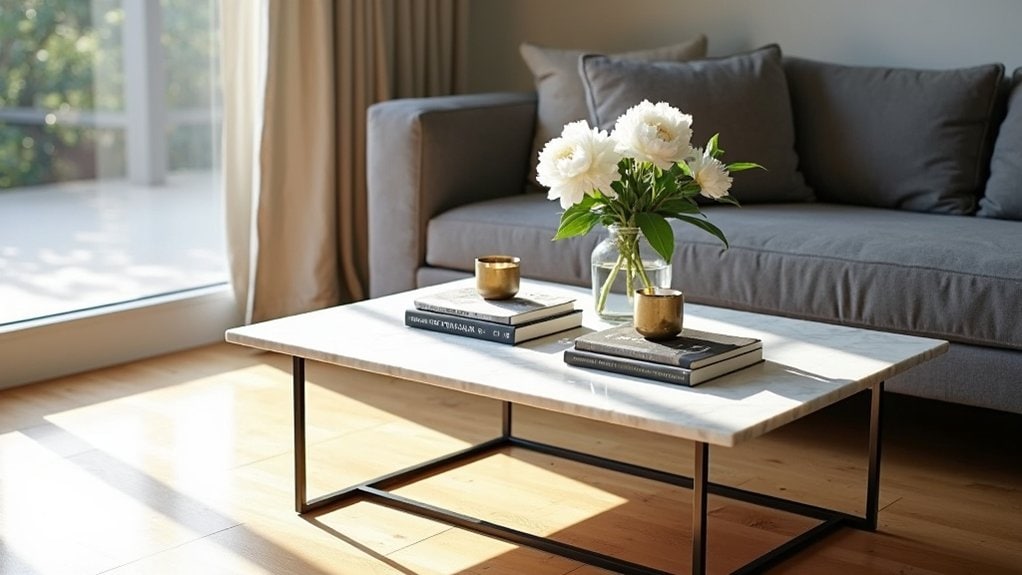
If you’ve got a loveseat or a smaller sofa, you’ll want a coffee table that actually fits the scale of the piece—something too large just crowds the room and feels off. Round tables tend to work really well here because they soften the layout and leave more open floor space, though a slim rectangular option can work too if you need the surface area. The key is thinking about what you actually need the table to do—storage, display space, everyday use—so you’re not just picking something that looks right but ends up being kind of useless.
Sizing Down Proportionally
When you’re working with a loveseat or a small sofa, a coffee table that’s too large will just eat up the space and make the whole setup feel cramped. Proportional balance really matters here more than people think.
A good starting point: your coffee table shouldn’t be wider than two-thirds of your sofa’s length. So if your loveseat runs about 60 inches, you’re probably looking at something around 36 to 40 inches max.
Visual harmony comes from keeping things in the same general scale. Nothing too bulky, nothing that fights for attention.
Think about the legs too. Slim, open-base tables tend to feel lighter in a smaller space. Does your current table actually fit, or have you just gotten used to it feeling slightly off?
Round Versus Rectangular Tables
Shape actually does a lot of heavy lifting in a small space, and the choice between round and rectangular tables isn’t just aesthetic.
Round tables tend to work better with loveseats. No sharp corners means easier movement around tight furniture arrangements. That matters more than you’d think.
Rectangular tables offer more surface area, which helps with functionality balance if you’re someone who actually uses the coffee table — remotes, books, a drink or two.
But here’s something worth considering: does your sofa’s shape influence your preference? A curved loveseat sometimes feels awkward paired with something very linear.
Your design aesthetics matter, but so does how you actually live in the space. Round might feel softer. Rectangular might feel more purposeful. Neither is automatically the right answer.
Maximizing Small Space Functionality
Small spaces have a way of making every furniture decision feel higher stakes than it probably needs to be.
But with a loveseat or small sofa, your coffee table actually has a real opportunity to pull some extra weight.
Look for multi functional furniture — tables with drawers, lift tops, or shelves underneath. That kind of thing genuinely helps when square footage is tight.
Vertical storage matters too. A table with a lower shelf keeps books, remotes, or baskets off the floor without spreading outward.
Ask yourself what you actually need the table to do daily. Storage? Surface space? Both?
A smaller footprint doesn’t mean you sacrifice function. You just have to be a little more intentional about what you pick.
Choosing the Right Material for Your Coffee Table

The material you choose for your coffee table matters more than most people think. Wood versus metal isn’t just about looks — it’s about how you actually live. Do you have kids? Pets? Wood scratches. Metal dents. Both age, just differently.
Glass durability is something people underestimate. Tempered glass holds up better than you’d expect, but it still shows every fingerprint and water ring. That gets old fast.
Think about your cleaning habits honestly. If you’re not wiping things down regularly, glass probably isn’t for you.
Wood feels warmer, more forgiving in a lived-in space. Metal reads cooler, more structured. Neither is wrong.
What matters is whether the material fits how you actually use the room — not just how it looks in a photo.
How to Arrange Your Coffee Table Without Blocking Flow
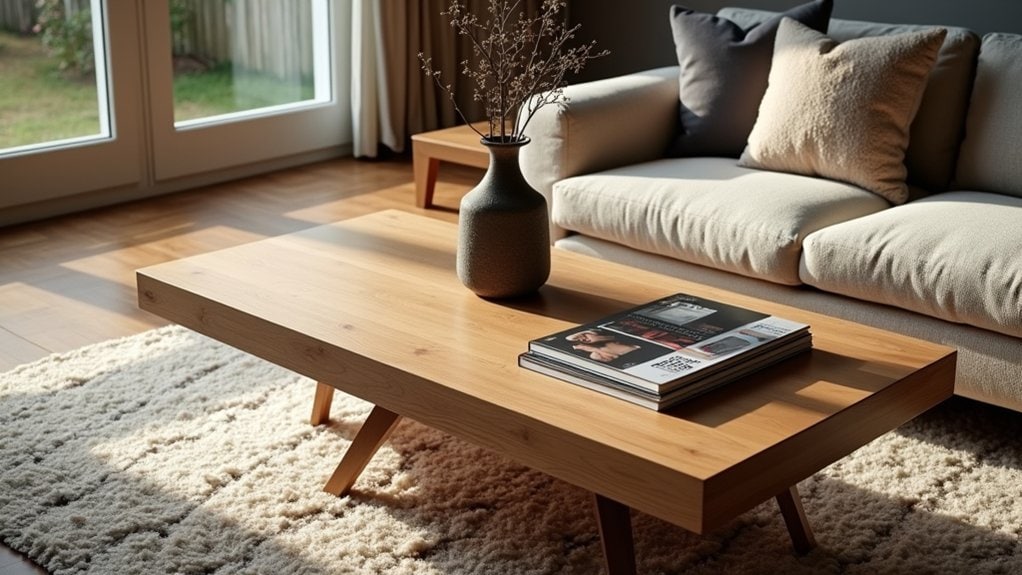
Once you’ve figured out what your table’s made of, where you put it — and how you arrange things on and around it — matters just as much.
You want flow enhancement, meaning people can actually walk around without bumping into corners. A good rule? Keep at least 18 inches between your sofa and the table’s edge.
Don’t center everything perfectly. Visual balance doesn’t mean symmetry — it means nothing feels too heavy on one side. Try grouping a few objects at different heights instead of lining things up.
And honestly, less is more here. A cluttered table pulls attention in weird directions.
Does your current setup let someone grab a drink without leaning awkwardly? If not, that’s probably worth adjusting first.
Frequently Asked Questions
Can I Use Two Smaller Coffee Tables Instead of One Large One?
Yes, you can absolutely use two smaller coffee tables! They offer incredible style versatility, letting you mix shapes and materials. You’ll also benefit from space efficiency, as you can rearrange them to suit different needs effortlessly.
What Budget Should I Set for a Quality Coffee Table?
You’ll want to budget $150–$500 for a quality coffee table. Consider material options like wood or metal and size considerations for your space, as these factors directly influence pricing and long-term durability and value.
How Often Should I Replace or Update My Coffee Table?
You don’t need to replace your coffee table often — only when it’s worn, damaged, or outdated. Revitalizing coffee table styles every 7–10 years works well, especially when exploring new material options that better suit your evolving space.
Can a Coffee Table Double as Extra Seating for Guests?
Yes, your coffee table can absolutely double as extra seating! You’ll find plenty of stylish options in multi-functional furniture, like ottomans with trays. They let you comfortably seat guests while maintaining a chic, practical living space.
Should My Coffee Table Match My TV Stand or Entertainment Unit?
They don’t need to match exactly, but you’ll want style coordination between them. Consider material considerations like wood tones or metal finishes to create a cohesive, intentional look that ties your living space together beautifully.
Final Thoughts
Finding the right coffee table doesn’t have to feel overwhelming. You’ve got the basics now — size, shape, material, and flow all matter, but none of them need to be perfect. Think about how you actually use your living space day to day. Do you need storage? Extra surface space? Start there. A good coffee table should just work for you, quietly, without demanding too much attention.