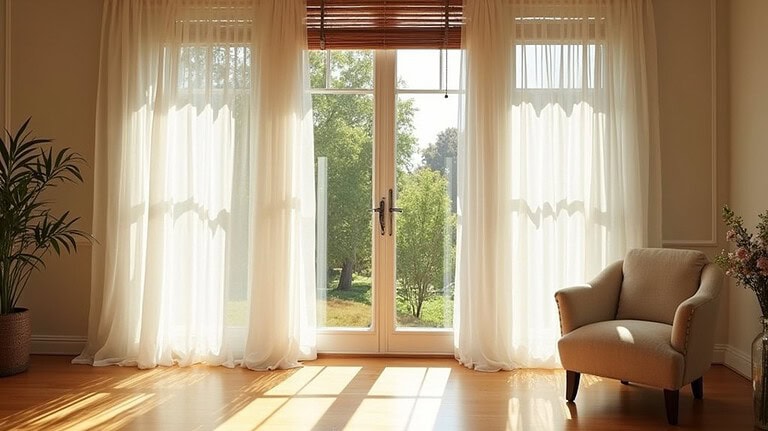
If your room feels darker than it should, your window treatments might be the problem. Heavy drapes, cheap blinds, or even just the wrong shade of fabric can eat up a surprising amount of light. It’s worth asking — are your curtains actually helping the room, or just hanging there? There’s a lot to reflect on here, from sheer fabrics to rod placement, and some of it might genuinely surprise you.
The Essentials
- Sheer curtains diffuse harsh sunlight while maintaining ambient glow, creating an open feel without significantly reducing natural light.
- Mount curtain rods 8–12 inches beyond the window frame and higher to maximize light entry and enhance vertical space.
- Solar shades and sheer roller blinds filter glare effectively while preserving outdoor views and maintaining room brightness.
- Light-colored curtains in soft whites, creams, or pale grays reflect more light, while darker fabrics absorb and reduce brightness.
- Layering sheer curtains over blinds provides flexible light control, softening glare without completely blocking natural light.
Why Your Current Window Treatments Are Blocking Natural Light

If you’ve never really thought about how your window treatments affect the light in your room, you’re not alone. Most people pick curtains or blinds based on looks, not function.
But here’s the thing — your treatment styles might be the reason your space feels dim even on sunny days.
Heavy drapes, thick valances, layered panels — these all use light blocking materials that eat up way more natural light than you’d expect.
Even sheer curtains can reduce brightness when they’re bunched up or hung too close to the glass.
So ask yourself: are your treatments actually working for you, or just sitting there looking nice?
Sometimes the fix is small. Sometimes it means rethinking your whole setup.
Sheer Curtains That Let Natural Light Flow Freely
When it comes to letting light in without sacrificing privacy, sheer curtains are probably the most straightforward option you’ll find.
Sheer fabrics handle light diffusion really well — they soften harsh sunlight without killing the ambient glow your room needs. The airy textures make spaces feel open, less boxed in.
Your fabric choices matter more than you’d think. Color transparency shifts depending on the weave density, so a white sheer behaves differently than an ivory one in afternoon light.
Soft draping affects light play too. How you hang them changes everything.
Layering techniques — like pairing sheers with heavier panels — give you flexibility throughout the day. Window aesthetics improve naturally when you stop overthinking it and just let the sheer do its job.
The Best Blinds for Maximizing Daylight in Any Room

If you’re trying to get the most daylight into a room, blinds can actually work better than you’d expect—it really comes down to choosing the right type. Sheer roller blinds and light-filtering cellular shades are probably your best options because they soften incoming light without blocking much of it. Have you thought about which rooms need the most natural light, and whether you actually want privacy too, or just more brightness?
Top Light-Maximizing Blinds
Blinds get a bad reputation when it comes to natural light, and honestly, that reputation isn’t entirely undeserved.
But the right blinds actually work with your light, not against it.
Solar shades use smart materials that filter glare while keeping your view intact. Sheer horizontal blinds lean into adjustable designs, letting you tilt the slats to redirect sunlight rather than block it. If eco-friendly options matter to you, bamboo blinds bring versatile textures and a warmer feel.
Minimalist styles in neutral tones tap into color psychology — lighter colors bounce light further into a room.
Some blinds even offer thermal performance, which helps regulate temperature without sacrificing brightness.
What’s your room actually missing — light control, decorative functionality, or both? That question shapes everything.
Choosing Sheer Blind Options
Sheer blinds take what works about solar shades and push it a step further — softer materials, more diffusion, less of that office-building feel.
You’ve got real choices with sheer fabric types now. Woven linen blends, polyester voiles, layered S-curve fabrics — each handles light a little differently. Some feel almost romantic. Others just feel practical.
Sheer opacity levels matter more than people realize. A 1% to 3% openness factor still filters UV without blocking your view. Go higher and you’re basically letting everything in.
Think about what you actually need. Privacy during the day? Glare control in the afternoon? Those two goals sometimes pull in opposite directions.
Sheer blinds don’t solve everything, but for rooms where daylight is the whole point, they’re worth a serious look.
Light-Filtering vs. Blackout Shades: Which Do You Need?
How do you actually decide between light-filtering and blackout shades?
Start with your room’s purpose. A living room benefits from light filtering benefits like softened natural glow without full darkness. You still get privacy. You still feel connected to the outdoors. That matters more than you’d think.
But bedrooms? That’s where blackout shade drawbacks become worth tolerating. Yes, they block everything—sometimes too aggressively. Rooms can feel sealed off, almost claustrophobic during the day. Some people don’t mind. Others really do.
Ask yourself when you actually use the room most. A home office with afternoon glare needs something different than a nursery.
There’s no universal answer here. It really depends on your habits, your schedule, and honestly, how much darkness you can handle.
Solar Shades: Natural Light and Privacy Without the Tradeoff

Solar shades offer a third option that a lot of people overlook when they’re stuck choosing between too much light and too much darkness. They filter glare without blocking your view entirely—which, honestly, is kind of the whole point if you’ve got a nice yard or street-facing window you don’t want to cover up completely.
One of the bigger solar shade benefits is that you can still see outside during the day while people outside can’t easily see in. That’s a real privacy solution, not just a marketing claim.
They work best in rooms that get direct afternoon sun. Living rooms, home offices, sunrooms—those are the obvious fits.
Does your space get harsh midday light? Solar shades might be worth looking at more seriously.
Window Treatments That Work Best for North-Facing Rooms
North-facing rooms don’t get a lot of direct sunlight, so the challenge isn’t really about blocking light—it’s about keeping whatever natural light you have.
North facing challenges are mostly about maximizing what little diffused light enters your space. Sheer curtains in white or light linen work well here. They won’t block anything, but they’ll soften the look without eating up brightness.
Avoid heavy drapes or dark roman shades—those are basically fighting against you.
Optimizing light in these rooms also means thinking about your window frame itself. Can you mount treatments outside the frame to expose more glass? That small shift actually makes a noticeable difference.
What about mirrors near the window? Sometimes the treatment isn’t just the fabric—it’s everything working together around it.
How Curtain Placement and Height Affect Natural Light

Where you hang your curtains matters more than most people think—mounting them closer to the ceiling rather than just above the window frame can make your room feel taller and pull in noticeably more light. You’ll also want to extend the curtain rod several inches beyond each side of the window, so the panels stack onto the wall instead of blocking the glass when they’re open. It’s a small shift, but it can genuinely change how bright a room feels during the day.
Mounting Height Matters
Where you hang your curtains matters more than most people realize — honestly, it can change how a room feels entirely.
Most people default to mounting right above the window frame. But height variations make a real difference. Try hanging your rod closer to the ceiling instead. You’ll pull more light into the space without adding a single window.
Different mounting techniques work better depending on ceiling height and window size. Higher mounts create visual lift and let light travel further into the room. Lower mounts can accidentally block light before it even gets a chance to spread.
So ask yourself — are your curtains actually helping your light, or just sitting there?
Small adjustments in mounting height genuinely shift how bright and open a room feels day to day.
Width Placement Tips
Height isn’t the only thing that changes how light moves through a room — width matters just as much, maybe more in some cases.
When you hang curtains too close to the window frame, you block light even when they’re open. Try extending the rod 8–12 inches beyond each side of the frame.
Use width measurement techniques to figure out how far your panels actually need to travel when open — most people don’t calculate this part.
Here’s what actually helps:
- Mount rods wider than the window itself
- Stack curtain panels completely off the glass when open
- Factor panel width into your ideal curtain lengths calculations before buying
How wide is your rod right now? That number probably matters more than you think.
Window Treatment Colors That Maximize Natural Light
When it comes to window treatments, color does more than just set the mood—it directly affects how much natural light bounces around your room.
Light enhancing hues like soft whites, creams, and pale grays work really well here. They don’t absorb light—they push it back into the space.
Reflective materials, like sheer linen blends or subtle metallic weaves, take that even further. A thin white sheer, for example, can soften harsh afternoon sun while still keeping your room bright.
Darker colors pull light in and hold it. That’s not always bad, but if you want brightness, it’s worth reconsidering that navy panel you’ve been eyeing.
What’s the current color on your windows? That answer might already explain a lot.
How to Layer Sheers and Blinds Without Losing Natural Light

Layering sheers over blinds is one of those things that sounds like it might block too much light, but it actually doesn’t have to. If you keep your blinds raised or tilted open during the day, the sheers do most of the work—softening glare while still letting brightness through. You’re really just giving yourself more control over how much light comes in at different times.
Layering Sheers Over Blinds
Combining sheers with blinds is one of those window treatment combos that actually works really well—if you set it up right. You want your blinds doing the heavy lifting for privacy, while your sheers soften the light coming through. Think about how different sheer textures catch light differently—a loosely woven sheer lets in way more than a tighter weave. Same goes for blind styles: wood blinds block more than cellular ones.
Here’s what actually helps:
- Mount your blinds inside the frame and hang sheers outside so they don’t compete
- Keep blinds tilted open during the day so light filters through both layers
- Choose lighter sheer textures if your room already feels a little dark
Does your current setup actually let enough light in?
Maximizing Light With Layers
Mount your blinds inside the frame. Then hang your sheers outside and higher—closer to the ceiling. That gap matters more than you’d think.
Layering fabrics only works well when the sheer is actually sheer. Not just labeled that way. Hold it up to a window before you buy.
Controlling glare is usually why people layer in the first place. But too many layers just block everything.
So ask yourself—are you trying to soften the light, or just dim it?
There’s a difference, and your answer should probably drive every choice you make after that.
The Cheapest Ways to Brighten a Room With Window Treatments
There are a few surprisingly affordable options to brighten a room without spending much on window treatments. You don’t need a huge budget to make a real difference. Sometimes the simplest DIY solutions work better than you’d expect.
- Hang sheer white curtains from a tension rod — no drilling, no fuss, and they let in soft, diffused light
- Swap heavy drapes for lightweight linen panels you can find at thrift stores or discount retailers
- Mount your curtain rod higher and wider than the window frame to visually expand the space and allow more light in
Have you considered how much light your current setup might actually be blocking? Small changes, honestly, can shift a room more than you’d think.
Frequently Asked Questions
Can Window Treatments Help Reduce UV Damage to Furniture and Flooring?
Yes, you can protect your home with UV-filtering window treatments! They’ll block harmful rays, delivering UV protection benefits that preserve your furniture longevity, preventing fading and deterioration while still letting you enjoy abundant natural light.
Do Smart Motorized Blinds Improve Natural Light Control Throughout the Day?
Yes, smart motorized blinds absolutely improve your light control! They’re equipped with light sensors that trigger automation benefits throughout the day. You’ll enjoy energy savings, user convenience, and design aesthetics while smart technology smoothly adjusts your blinds for ideal natural light.
How Do Window Treatments Affect Energy Bills During Winter Months?
You’ll reduce your energy bills greatly by choosing treatments with strong insulation properties. Cellular shades and thermal curtains trap heat, boosting energy performance and preventing cold drafts from entering, keeping your home warmer without overworking your heating system.
Are There Child-Safe Window Treatment Options That Still Maximize Natural Light?
You’ll find child safe shades with cordless designs offer both safety and brightness. Pair them with sheer curtains to filter soft, natural light beautifully while keeping little ones protected from dangerous cord hazards.
Can Window Film Be Combined With Curtains for Better Light Management?
Yes, you can combine window film benefits with various curtain styles for ideal light control! You’ll reduce glare with film while sheer curtains diffuse soft light, and heavier drapes let you block light completely when needed.
Final Thoughts
You don’t need a big budget to get more light into your space. A few small changes — hanging rods higher, swapping heavy panels for sheers, picking lighter colors — can make a noticeable difference.
Think about what’s actually blocking your light right now. Is it the fabric? The placement? Maybe both.
Start with one window. See what happens. You might be surprised how much brighter a room gets with just one or two adjustments.